Jewels Magic: Mystery Match 3
- 4.7
- Rating
- 10.00M
- Installs
- Free
- Price

 Analysis by App-foxy
I usually turn to match-three games when I want something easy to start and simple to pause, but I still want a little more structure than endlessly swapping random tiles. Jewels Magic: Mystery Match 3 fits that mood well. It is a free puzzle game from Puzzle1Studio built around jewel-matching levels, a large offline-friendly campaign, and a relaxed style that makes it suitable for short breaks.
After spending time with it, I see the main appeal clearly: this is not trying to replace a deep strategy game or become a social competition. It is a straightforward mobile puzzler that gives you a long sequence of boards to work through. The best parts are the immediate controls, the magical visual theme, and the ability to play without depending on a constant connection. The weaker parts are equally familiar for the genre: progress can become repetitive, difficult boards may encourage extra attempts or purchases, and players looking for a radically different puzzle system may find the formula conservative.
How the current version feels to play
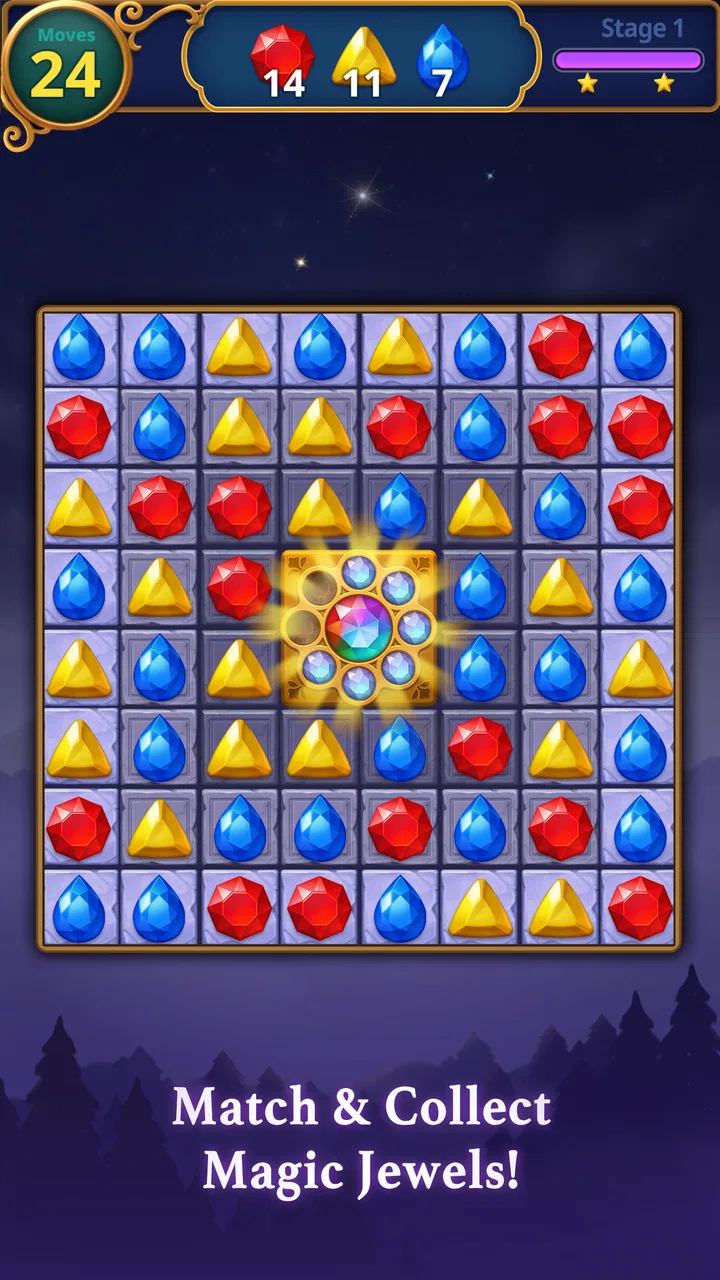
The core loop is instantly understandable. I look for matching jewels, make a move, and try to complete the objective before the available moves run out. That simplicity is useful because I do not have to learn a complicated interface before playing. A few minutes are enough to understand the rhythm, while longer sessions can become a steady progression through the campaign.
You May Also Like

 Pandora - Music & Podcasts
Pandora’s Music Is Easy to Start, but Harder to Recover
Pandora’s strength is its low-effort path from a seed to a station. Its weak spot is how much confidence it asks you to place in connection, setup, and quiet recovery.

 8 Ball Pool
 Is Built on Rivalries, Rematches, and Routine
A close look at the rivalries, rematches, shared routines, and unanswered safety questions that turn a quick pool match into a persistent mobile community.

 Samsung Music
’s Quiet Strength Is Playing What You Already Own
Its reach comes less from spectacle than from dependable access to a personal library. That simplicity is both the app’s strongest retention engine and its ceiling.

 AccuWeather: Weather Radar
AccuWeather Review: A Quick, Clear Forecast for Everyday Decisions
For everyday plans, the best forecast is the one you can understand quickly. AccuWeather makes rain timing, radar, and local conditions easy to act on, with a few trade-offs.

 Hill Climb Racing
Why Hill Climb Racing Still Turns Crashes Into One More Run
A tiny car, a bumpy hill and one more upgrade: Hill Climb Racing keeps resurfacing because its simple chaos makes every near-miss feel personal.

 AliExpress - Shopping App
AliExpress Makes Global Shopping Feel Personal, but Shoppers Bear the Risk
AliExpress turns a global marketplace into a pocket-sized discovery engine. Its reach is useful, its shopping loop compelling, and its trade-offs easy to miss.
More From Our News Desk
View All News


The game is listed as having more than a thousand levels, which gives it a much larger sense of progression than a small collection of casual puzzles. That scale is valuable if you want one game to keep installed for occasional use. It also changes how I judge each board: a single difficult stage is less frustrating when I know there is a substantial journey ahead, although repetition becomes more noticeable over time.
The offline focus is one of the most practical parts of the experience. I can imagine using it on a commute, in a waiting room, or during a flight when I want a distraction that does not rely on streaming content. Offline play also makes the game feel less demanding than puzzle titles that constantly push events, rankings, or social activity. For me, that makes it a better fit for quiet solo sessions than for players who need competition to stay interested.
The presentation uses a magical jewel theme rather than a realistic or minimalist design. That gives the boards a recognizable identity without making the rules harder to follow. The bright pieces and clear matching pattern help the game remain approachable, especially for someone who has not played many match-three titles. The theme is decorative rather than a deep narrative system, so I would not choose this game expecting a story-heavy adventure.
A gentle learning curve with familiar rules
One reason the game works for casual players is that the opening experience does not demand much explanation. Match-three conventions are already familiar to many mobile users, and Jewels Magic builds on that knowledge instead of replacing it with unusual controls. I found that useful when playing in short bursts because I could return after a few days without having to remember a complex set of commands.
That accessibility also creates the main trade-off. Players who enjoy discovering completely new puzzle mechanics may find the early stages too recognizable. The enjoyment comes from planning the board, spotting useful combinations, and handling the specific goal of each level, not from learning an entirely new genre. I think that is a sensible choice for a game designed to be picked up quickly, but it limits its appeal for expert puzzle fans who want constant novelty.
My practical advice is to avoid making every move as soon as a match appears. I get better results by first scanning the whole board, checking whether a move can open a larger combination, and only then committing. This small habit matters more than speed. It is especially useful when a level gives a limited number of moves, because an attractive match near the top may be less valuable than a move that changes several rows below it.
What the version information tells existing players
The current version is 2616.0.0, so the game is clearly still presented as a maintained product rather than a forgotten one. That does not automatically tell me that every part of the experience has changed recently, and I would not treat a version number as proof of a major redesign. What it does provide is a useful reference point: players returning after time away can compare their installed build with the current release before judging whether their experience is up to date.
The game originally arrived on May 1, 2019, which helps explain its established structure. It is not a brand-new experiment built around a temporary trend. A long-running match-three title has the advantage of a familiar, settled format, but it can also feel less surprising than newer games that build their identity around unusual mechanics or stronger narrative hooks.
For someone already playing, the most important effect of the current state is continuity. The large level journey remains the reason to return, and the offline orientation keeps the game useful when internet access is inconvenient. I would not reinstall it expecting a completely different genre experience. I would reinstall it if I wanted more boards in the same accessible style and appreciated having a puzzle game that can fit around my schedule.
How I would use it in everyday life
A realistic use case is a ten-minute break between tasks. I can start a board, think through a few moves, and stop without needing to follow a live match or coordinate with other players. If the level takes longer than expected, the pause-friendly structure makes it easier to treat the game as a flexible activity rather than a commitment.
It also suits travel better than some visually heavier puzzle games because the central activity is easy to understand even when I am distracted. I would still check that the game is installed and ready before leaving home, rather than assuming every future situation will be convenient. The offline promise is a strong reason to keep it available, but the quality of a session still depends on battery, screen comfort, and whether the device handles the game smoothly.
Another useful approach is to use it as a low-pressure alternative to social feeds. Instead of opening an app that constantly changes, I can work through a self-contained puzzle and stop after one board. That makes it a good choice for people trying to keep their breaks more deliberate. On the other hand, anyone who tends to continue playing simply because another level is available should set a personal stopping point; a long campaign can make “one more round” surprisingly easy.
Progression, difficulty, and the value question
The free entry point is important. I can try the game without paying first, which lowers the risk for anyone unsure whether this style of puzzle will hold their attention. The age rating is Everyone, so its general presentation is approachable for a broad audience. That does not mean every player will enjoy it equally: younger users may need guidance around optional spending, while adults may prefer a title with fewer monetization prompts or a one-time purchase.
In-app purchases range from $0.49 to $99.99 per item. That is a wide span, and it changes how I evaluate the free experience. I would treat purchases as optional conveniences rather than part of the basic reason to install the game. Before spending, I would first try replaying a difficult level with a slower board scan and a different opening move. In match-three games, a small change in planning can sometimes matter more than an immediate boost.
The trade-off is familiar: a free game can offer plenty of content, but the player may encounter pressure to use resources or pay when progress slows. I would recommend keeping purchases under conscious control, especially on a shared device. If your priority is a completely uninterrupted puzzle experience with a clear fixed cost, a paid premium alternative may be a better fit even if it offers fewer stages.
The game’s average rating is 4.7 from around 95 thousand ratings, while the store shows roughly 20 thousand written reviews. Those figures suggest that many players respond positively to the formula, but they should not replace personal testing. High ratings are most useful here as a sign that the basic loop works for a broad audience, not as a guarantee that the pacing or monetization will suit everyone.
Where it stands beside other match-three choices
Compared with heavily social match-three games, this one feels more focused on the board in front of me. I do not need a competitive mindset to get value from it. That is a strength if I want a calm solo activity, but a weakness if daily challenges, teams, rankings, and player interaction are what keep me engaged.
Compared with story-led puzzle adventures, Jewels Magic puts less emphasis on characters and plot. Its motivation comes from clearing stages and seeing how far I can progress. I prefer that when I want immediate play, but I would choose a narrative alternative when I want the puzzles to support a larger emotional journey.
Compared with minimalist puzzle games, the magical jewel presentation is more colorful and traditional. It communicates the genre quickly, though it may feel busy to players who prefer clean geometric designs. The choice comes down to atmosphere: this game wants to feel like a casual fantasy-themed board, not a stark logic exercise.
Its offline orientation is another meaningful distinction. Many mobile puzzle games are designed around ongoing connectivity and recurring content. Here, the ability to play offline makes the title more dependable for travel and disconnected moments. The compromise is that the experience may feel less dynamic than games built around constantly changing online activities.
Small techniques that improve the experience
My first useful technique is to treat the bottom of the board as strategically important. Moves lower down can create cascades that alter more of the layout, while a quick match near the top may produce only a small immediate gain. I do not follow this rule blindly, but it gives me a better starting point when several legal moves look equally attractive.
Second, I try not to spend a helpful combination merely because it is visible. If the level objective rewards a particular type of clearing, I save the opportunity until it supports that goal. This is one of the differences between casually matching and actually managing a board. The game remains easy to control, but the limited-move structure makes patience worthwhile.
Third, I use a failed attempt as information rather than immediately treating it as a reason to pay. I ask which part of the board caused the problem: did I waste early moves, miss a cascade, or focus on ordinary matches instead of the level’s target? That review takes only a few seconds and can make the next attempt feel more deliberate.
Finally, I separate “I am stuck” from “I am bored.” If I am stuck, changing my opening strategy may help. If I am bored, purchasing assistance will not solve the real issue. The long campaign is a benefit only when I still enjoy the central matching loop, so I would stop playing rather than spend money to force progress through a style I no longer like.
Who should install it, and who should skip it
I would recommend it to someone who wants a familiar puzzle format, a large supply of levels, and the freedom to play offline. It is especially suitable for short breaks, casual travel, and players who prefer solo progress over social competition. The Everyone rating and free starting point also make it easy to explore without a large initial commitment.
I would be more cautious recommending it to players who dislike repeated board structures, want a strong story, or expect every stage to introduce a new mechanic. I would also point competitive players toward a game with deeper rankings or multiplayer features. Anyone who strongly prefers a purchase-once experience should compare the optional spending model with premium puzzle games before settling in.
Device compatibility is straightforward for many older Android users because the minimum requirement is Android 6.0. That makes the game accessible across a broad range of devices, although an older operating system alone cannot guarantee identical performance on every phone or tablet. I would install it on the device I actually plan to use and judge comfort from the board size, touch response, and battery behavior during a normal session.
What I would watch as the game continues
For existing users, I would watch how future updates affect the balance between the long level journey and the core simplicity. A useful update would preserve quick access to offline puzzles while making progression feel varied enough for returning players. I would also pay attention to whether optional purchases remain easy to ignore or become more central when levels grow harder.
I would not assume that a higher version number means every personal frustration has been solved. The current build is a useful snapshot, but the real test is how the game feels during repeated sessions: whether boards remain readable, whether difficulty feels fair, and whether the campaign still gives a satisfying reason to continue. Those are better questions than simply asking whether the app is new.
After weighing those points, I see Jewels Magic as a dependable casual puzzle rather than a genre revolution. Its strongest combination is the familiar matching loop, the magical visual identity, and a substantial offline campaign that can fit into ordinary spare moments. Its limitations are the same reasons some players may leave: the formula is traditional, the journey can become repetitive, and optional purchases require self-control.
My honest recommendation is to try it if you want a low-friction match-three game that travels well and does not demand your full attention. I would keep it installed for commutes and short breaks, but I would choose another option for competitive play, a richer story, or a fully premium experience. As a free puzzle game from Puzzle1Studio, it earns its place through convenience and volume rather than surprise, and that is a worthwhile trade-off when simple, offline entertainment is exactly what I need.
FAQs for Jewels Magic: Mystery Match 3
01What is Jewels Magic: Mystery Match 3?
Jewels Magic: Mystery Match 3 is a casual puzzle game based on the classic match-three formula. You swap colorful jewels to create lines of three or more matching pieces, clear obstacles, complete level objectives, and earn rewards. The game adds a light adventure and mystery theme, making it suitable for short sessions as well as longer play periods when you want a relaxing but progressively challenging puzzle experience.
02How do you play Jewels Magic: Mystery Match 3?
Gameplay is simple to understand: move adjacent jewels horizontally or vertically to form matching combinations. Matching four or more jewels can usually create special pieces with stronger clearing effects, which are useful for removing difficult obstacles and completing objectives efficiently. Each stage may have different goals, so blindly making matches is not always the best strategy. Planning moves and combining special jewels becomes increasingly important.
03Is Jewels Magic: Mystery Match 3 free to download and play?
The game is generally available as a free download, allowing players to begin the adventure without paying upfront. However, free-to-play puzzle games commonly include optional in-app purchases, such as extra moves, boosters, lives, or other helpful items. You can progress without necessarily spending money, but some challenging levels may encourage the use of assistance. Check your device’s purchase settings if children may access the game.
04Can Jewels Magic: Mystery Match 3 be played offline?
Many of the core puzzle levels can usually be enjoyed without a continuous internet connection, which makes the game convenient for travel, commuting, or playing in areas with weak reception. Nevertheless, certain features may require internet access, including advertisements, cloud-related functions, updates, events, or purchases. Offline availability can also vary between versions and devices, so it is best to launch the game online first and test the features you need.
05Is Jewels Magic: Mystery Match 3 suitable for all ages?
Jewels Magic: Mystery Match 3 is designed as an accessible casual puzzle game, with straightforward controls that most players can learn quickly. Its colorful jewel-based presentation and non-violent gameplay make it appropriate for a broad audience. Parents should still review advertising and in-app purchase settings, especially for younger players. Later stages may become noticeably more difficult, so children may need help understanding objectives and managing limited moves.
Pros
- Easy-to-learn match-3 mechanics suitable for quick casual sessions.
- Colorful graphics and magical effects make matches satisfying to watch.
- Hundreds of levels provide plenty of content for puzzle fans.
- Power-ups help clear difficult boards and create exciting combinations.
- Playable offline
- making it convenient for travel or limited connections.
Cons
- Some later levels can feel heavily dependent on luck rather than strategy.
- Energy or life limits may interrupt longer play sessions.
- Frequent boosters can make progression feel less rewarding.
- Ads may appear between levels or after certain in-game actions.
- The core match-3 formula may feel repetitive over extended play.

Jewels Magic: Mystery Match 3
Gallery